
MIT projects selected for funding under US Department of Energy’s Genesis Mission
Initial research projects advance national priorities across natural resources, manufacturing, nuclear physics, and more.
Initial research projects advance national priorities across natural resources, manufacturing, nuclear physics, and more.
Researchers developed an auditing technique to test generative AI models for malicious capabilities, without prompting them for illegal outputs.

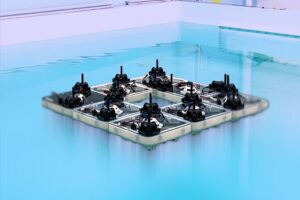
MIT researchers developed FloatForm, a swarm of small aquatic robots that snap together like ants forming a raft, assembling into reconfigurable structures…
A USAF cadet and a Lincoln Laboratory researcher found AI chatbots can help nontechnical service members produce viable software applications for their unique problems.
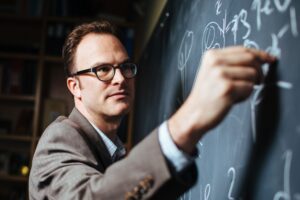
The professor of physics and inaugural director of the NSF AI Institute for Artificial Intelligence and Fundamental Interactions will lead LNS and…
During a "Washington Post Live" panel discussion with ASU President Michael Crow, President Sally Kornbluth explored how universities are preparing the next…

Computer scientist Phillip Isola cuts through the hype to explain how AI agents work and what the future might hold for this rapidly advancing…
Associate Professor Anna Huang delivers the keynote address, “In Search of Human-AI Resonance,” to a capacity crowd.

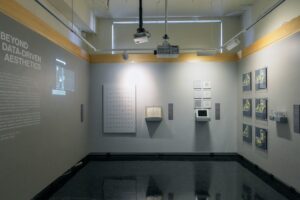
In a new Keller Gallery exhibition, Alexandros Haridis SM ’17, PhD ’22 traces centuries of ideas about aesthetic judgment and explores how…
A faculty member since 1999, Autor is a leading researcher in artificial intelligence and the work of the future.
“Scientific American” showcases the history and future of America’s scientific engine, highlighting promising young scientists and icons at MIT and beyond.

A new system, known as Murakkab, optimizes the design and deployment of multistep workflows that power AI applications.

Researchers combined an efficient algorithm with dedicated hardware to rapidly generate 3D maps for navigation using minimal memory and power.
MIT researchers’ approach captures subtle atomic patterns, improving predictions of material properties.

Leaders, faculty across MIT discuss fostering innovation and talent in Greater Boston in special series of articles published alongside the outlet's annual…

A new spatial memory system for robots efficiently captures details about the objects they see while exploring their environment.